It's my first busy time of the year at work, so there's not much layout progress to report - and the progress there is, is pretty much invisible crews and such. Other than building a box to house my new NCE PowerCab components, I'm wiring up the (hopefully) last of my feeders!
Yes, like most folks, I was anxious to get the railroad up-and-running ASAP so I just installed enough feeders to get by. But now that we've had a bunch of operating sessions (and have completed what I hope are the last of the track modifications) and are now starting some scenery, it was time to audit/check what tracks didn't yet have feeders.
So, I reconnected all the feeders in the East End Staging yard and under the Saybrook Scene (including adding additional new ones), and I'm "finish feedering" the line from Essex up to East Haddam (electrifying every section of track). Click here and here for how I do feeders. I'm not going to take the time to go into it in this post since I have to get back to work!

Friday, January 13, 2017

Tuesday, January 10, 2017


Friday, January 6, 2017
Friday Fun: NCE Power Cab

I've needed another throttle for quite some time now . . .
and I could use a way to program & test locomotives in the comfort of my den, near my workbench.
Well, a late-arriving gift just arrived today and fit the bill for both!
I'm looking forward to putting this all together on a nice, portable mount/box that I can take anywhere and hook up easily to my test loop. I just haven't decided whether to use masonite or foamcore. Either way, I'll share here how I do it.
Merry Christmas/Happy Birthday to me!
Staging Script: Shoreline Trains Through Saybrook - c. 1948
So, now that I've expanded my staging to accommodate the traffic through Old Saybrook, the next, HUGE, question I needed to answer was the obvious one - "what trains went through Old Saybrook?" The answer isn't as straightforward as you might expect.
Fortunately, Old Saybrook - while not a major town on the New Haven - does have a Signal Station (tower SS-102) and a passenger station so it shows up in both the Employee Timetables and the Arranged Freight Service books. I had to consult and cross-reference them both in order to come up with a pretty close approximation of the traffic. I actually started this research in the summer of 2014, and got into it more last February (click here for more details on the resources used), but at that time focused only covered the mid-day traffic, when the two Shoreline locals would be in town.
But as my interest in the traffic through Old Saybrook grew (along with progress on the Saybrook scene), I wanted to include more trains. And now that my staging yards are expanded to their full potential (as inadequate as that might turn out to be), it was time expand my research to cover a full 3 hour operating session (12 "prototype" hours on a 4:1 fast clock) and figure out how the trains would interact with each other.
Below is a compilation of all that research:
That, my friends, is a detailed listing of all the trains through Old Saybrook from 7:10 in the morning (westbound freight BN-9) til 7:42pm (eastbound freight GB-8). All 33 of'em! As I mentioned earlier, I compiled it from information in the employee timetables and freight service books. John Wallace helped too by supplying the "station stop" info. And most interestingly, I was able to determine the actual locomotives used for each train using the railroad's engine utilization report from April 20, 1948 (read more about that here).
The table is pretty straightforward. The numbers in the left-most column tell the Shoreline crews how many actual, real minutes they have between trains (hint: it ain't much on a 4:1 fast clock). The next column gives the actual prototype train times, etc. The right-most columns tell the crews where to start each train - whether at New London (east end) or New Haven (west end) staging.
As you can see, I lucked out big time - most trains alternate eastbound/westbound, so I don't need as many staging tracks as you might expect (each track empties by the time it needs to be filled). The only exceptions (trains 12 & 182, 14 & FGB-2, and 402 & 26) are all eastbounds - and it just so happens that my largest staging yard is the east end yard which can receive these additional trains #FTW!
I can't wait to do a dress rehearsal to see how all this is gonna work!
But before that, some really cool things that became apparent as I compiled the engine assignments:
 |
| You really should click on the image to enlarge/read |
The table is pretty straightforward. The numbers in the left-most column tell the Shoreline crews how many actual, real minutes they have between trains (hint: it ain't much on a 4:1 fast clock). The next column gives the actual prototype train times, etc. The right-most columns tell the crews where to start each train - whether at New London (east end) or New Haven (west end) staging.
As you can see, I lucked out big time - most trains alternate eastbound/westbound, so I don't need as many staging tracks as you might expect (each track empties by the time it needs to be filled). The only exceptions (trains 12 & 182, 14 & FGB-2, and 402 & 26) are all eastbounds - and it just so happens that my largest staging yard is the east end yard which can receive these additional trains #FTW!
I can't wait to do a dress rehearsal to see how all this is gonna work!
But before that, some really cool things that became apparent as I compiled the engine assignments:
- A lot of engines are used twice during this 12-hr time period - yes, if you stood on the station platform long enough, you'd see some of the same engines coming back from where they went. So, even though there are 33 trains, I don't need as many different locos as you'd think.
- But I still need a lot of engines if I want to truly duplicate this traffic:
- One I-4 class Pacific (#1350)
- One A-B-A set of Alco FAs (New Haven class DER-2 #0418-0459-0419)
- Five I-5 class Hudsons (#1400-1403 & 1405)
- and a whopping 28 DL-109s! (DER-1)
Yes, the Diesel Era was certainly in full swing on the Shoreline by the spring of 1948!
As I've mentioned elsewhere, when I decided to include Old Saybrook on the layout, it was primarily 1) to have a nice scene to greet visitors when they first come down the basement stairs, and 2) to have a nice scene for the New London-Cedar Hill local to go through on its way up the Valley branch at the Saybrook wye.
But as you can tell, the Saybrook Scene has become so much more and the heavy Shoreline traffic that went through here in a typical day provides a really cool contrast to being out on the Valley branch all by yourself with the local freight. This contrast even shows up in the motive power - all but 7 of the 33 Shoreline trains are diesel-powered, while the Valley and Air Line locals are still all steam. While I didn't build all this contrast into the design from the beginning, it's certainly become a really cool bonus and provides another opportunity to tell the story of rail transportation during this era.
Now I just have to see if my staging yards are actually up to the task of supporting all these trains . . .
Thursday, January 5, 2017
Shoreline Traffic & Staging Expansion
As I mentioned earlier, at my last ops session it became quite apparent that the Shoreline/mainline trains - which had always been planned as bit players in the grand scheme - are starting to upstage the marquee actors. It's just really cool to see the parade roaring by on the mainline through Saybrook, all in stark contrast to the sleepy branchline locals.
While there were 71 trains through Old Saybrook during a typical day, I certainly don't have to model them all. I never plan to replicate a full 24hr period, and - in fact - could get by with just four mainline trains if I focus only mid-day, when the 2 Shoreline locals were scheduled to be in town. The problem with limiting my ops session to mid-day though is that my session would have the Airline and Valley locals operating for 1-2 real hours before the Shorelines locals would ever start and enter the scene at Saybrook.
So, for now, I'm experimenting with starting all the locals at the same time - 7am. That results in the Shoreline locals getting into Saybrook in the morning rather than midday - not prototypically perfect, but certainly plausible. And if I want to continue running the Shoreline trains until the last local typically leaves Saybrook for the day, I need to be prepared to run all the trains through town from 7am until 7:42pm at the latest. That's 33 trains, not counting the 2 locals(!).
What does that all mean? You guessed it - MORE STAGING!
Now, there's no way I can expand the staging yard at the west end of the Shoreline (New Haven/New York). As you can see here, I'm pretty well hemmed in and have only 4 tracks 8'3" long. So I needed at least to expand where I could - the east end staging yard (New London/Boston).

The pic above shows my main motivation for focusing on this yard (heh - other than the fact that I really had no other choice) - I spaced the track VERY far apart for ease-of-access. But many subsequent ops sessions confirmed that space could be put to better use - more tracks! To orient you, the staging yard is on homasote and those tracks in the background are for storage only and mounted directly to the plywood.

The photo above shows the expansion in-progress. I've already moved 3 staging tracks all the way over to the left (aisle side) edge of the homasote (the 4 tracks further to the left are storage only). Moving the staging tracks resulted in a slight, broad S curve, but I - and more importantly, the equipment - can live with that to shoehorn more tracks in. Look at all that real estate opening up!

Before I could move the tracks over, I had to unsolder the feeders. And when I went to reattach the feeders, I had to drill new holes at the new location. Since I'd be threading the ends of the feeders up through the bottom of the layout, I came up with the idea above to keep track of the proper holes.

As you can see, from underneath the layout it's really hard to tell which holes are the right ones. But these little skewers make it obvious.

In the post on my last ops session, I mentioned needing bumping posts at the end of the staging tracks (my engines have pretty high momentum and a few have Keep Alive circuits. 'nuff said). Here you can see clearly why they're necessary - and you can see mystingy cheap thrifty way of solving the problem.
As I've mentioned before, the east end staging yard was originally conceived as only a place where Shoreline local PDX-2 (New London/East Haddam/Cedar Hill) could originate off-stage.
And as you can see in the pic above, it was more than adequate for that lone purpose. But once I discovered all the cool Shoreline traffic (not to mention having a beautiful Saybrook scene to run it through), and decided to expand it 11 months ago (see post here), there was no turning back.
Yeah, that photo above is what the yard looks like as of today. Big difference from last February. By narrowing the track centers to 2", I was able to add three more staging tracks - including a dedicated "PDX-1 receiving track" coming off the main near the east end of Track 6. And BONUS! I had a turnout leftover, so I added yet another track to the storage yard over there on the left (as well as rerailers at the end of two of those tracks to facilitate adding cars to the layout).
Certainly a significant expansion, by any measure. But now truly maxed out. Don't even mention that "vacant" space to the right, near the wall. I want to keep that open for access.
So what's all this time and effort do for me? Well, I'm hoping that it'll make it easier to run those 33 trains I'd like to run. The next step is to see if it actually does.
While there were 71 trains through Old Saybrook during a typical day, I certainly don't have to model them all. I never plan to replicate a full 24hr period, and - in fact - could get by with just four mainline trains if I focus only mid-day, when the 2 Shoreline locals were scheduled to be in town. The problem with limiting my ops session to mid-day though is that my session would have the Airline and Valley locals operating for 1-2 real hours before the Shorelines locals would ever start and enter the scene at Saybrook.
So, for now, I'm experimenting with starting all the locals at the same time - 7am. That results in the Shoreline locals getting into Saybrook in the morning rather than midday - not prototypically perfect, but certainly plausible. And if I want to continue running the Shoreline trains until the last local typically leaves Saybrook for the day, I need to be prepared to run all the trains through town from 7am until 7:42pm at the latest. That's 33 trains, not counting the 2 locals(!).
What does that all mean? You guessed it - MORE STAGING!
Now, there's no way I can expand the staging yard at the west end of the Shoreline (New Haven/New York). As you can see here, I'm pretty well hemmed in and have only 4 tracks 8'3" long. So I needed at least to expand where I could - the east end staging yard (New London/Boston).

The pic above shows my main motivation for focusing on this yard (heh - other than the fact that I really had no other choice) - I spaced the track VERY far apart for ease-of-access. But many subsequent ops sessions confirmed that space could be put to better use - more tracks! To orient you, the staging yard is on homasote and those tracks in the background are for storage only and mounted directly to the plywood.
 |
| Another view of how spaced-out the original track configuration was. The placards more where I need to put feeders. |

The photo above shows the expansion in-progress. I've already moved 3 staging tracks all the way over to the left (aisle side) edge of the homasote (the 4 tracks further to the left are storage only). Moving the staging tracks resulted in a slight, broad S curve, but I - and more importantly, the equipment - can live with that to shoehorn more tracks in. Look at all that real estate opening up!

Before I could move the tracks over, I had to unsolder the feeders. And when I went to reattach the feeders, I had to drill new holes at the new location. Since I'd be threading the ends of the feeders up through the bottom of the layout, I came up with the idea above to keep track of the proper holes.

As you can see, from underneath the layout it's really hard to tell which holes are the right ones. But these little skewers make it obvious.

In the post on my last ops session, I mentioned needing bumping posts at the end of the staging tracks (my engines have pretty high momentum and a few have Keep Alive circuits. 'nuff said). Here you can see clearly why they're necessary - and you can see my
As I've mentioned before, the east end staging yard was originally conceived as only a place where Shoreline local PDX-2 (New London/East Haddam/Cedar Hill) could originate off-stage.
 |
| East End Staging, February 2016 |
 |
| I jogged the back (rightmost) staging track (PDX-1 receiving) to the left a little to keep it away from the edge. But looking at it now, if I'd kept it straight I could probably have avoided all those little S curves. No, I'm not going to redo it. |
Certainly a significant expansion, by any measure. But now truly maxed out. Don't even mention that "vacant" space to the right, near the wall. I want to keep that open for access.
So what's all this time and effort do for me? Well, I'm hoping that it'll make it easier to run those 33 trains I'd like to run. The next step is to see if it actually does.
Wednesday, January 4, 2017
Wordless Wednesday #152 - The Situation at Saybrook
 |
| Delivery of two new parlor cars - the Desiree and the Nina |
 |
| Saybrook Junction, east leg of the wye, showing the towers - signal and water - as well as the backside of the cemetery, with pine grove. |
 |
| West leg of the wye at Saybrook Jct - another view of the cemetery on the now-dead-ended old Middlesex Turnpike |
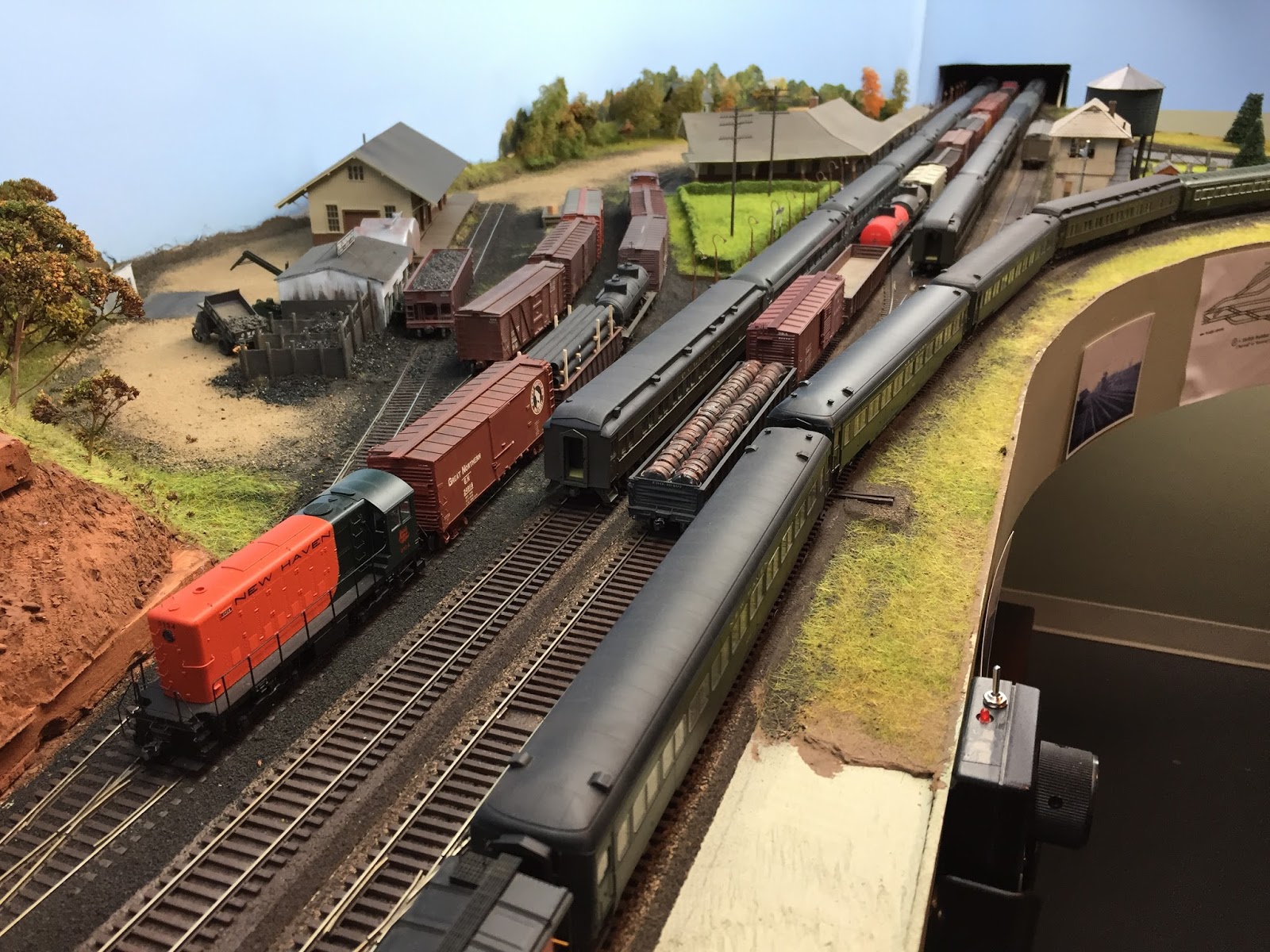 |
| All clogged up (as a result of moving all the equipment from the east end staging yard during expansion) |
 |
| Overview of a stuffed Saybrook |
 |
| View from the "stadium seating" (aka the basement stairway) |
Sunday, January 1, 2017
2016 In Review - 2017 Goals
HAPPY NEW YEAR!!
With the changing of the calendar comes the best opportunity to reflect, assess, and plan. This year is no exception, though with the so-called low hanging fruit of layout construction (mostly) done, future projects on the Valley Line promise to be a bit more involved, complicated, and slow-moving. But it's a hobby, not a job - thankfully - and that's all part of the fun. I actually look forward to these annual posts since it gives me an often-much-needed reminder of how far I've come (even while reminding me how far I still have yet to go). So, without any further ado, here's a look back and a look forward....
Here's where I started as 2016 dawned:
Goals for 2016
- By June 1 (in time for the NE Proto Meet (formerly Collinsville)):
- Finish the rest of the trackwork, including new "west end" staging yard as well as Essex/Deep River/East Haddam
- Install the rest of the backdrops & fascia
- Install the rest of the lighting
- Have either Old Saybrook or Wethersfield "done" - backdrop, buildings, signals, scenery.
- By December 31:
- Have either Old Saybrook or Wethersfield "done" (whichever isn't done already)
- At least start on Dividend and Cromwell, including the huge Hartford Rayon complex in Dividend.
- Have at least 4 operating sessions over the course of the year.
So, how'd I do?
- Completed the rest of the trackwork (golden spike here)
- Completed west end staging
- Finished the backdrops & fascia
- Installed the rest of the lighting
- And Old Saybrook is just about done - only an overpass and some additional details are left to do
- Since we're still working on Saybrook, I haven't gotten to Wethersfield - not to mention Dividend or Cromwell
- But I had NINE (count'em - 9!) operating sessions in 2016, including two in March alone!
- And - BONUS! - I (and by "I" I mean mostly/almost all BillS) did the Shailerville Bridge scene, start to finish
- Springfield show
- New England ProtoMeet (the ProtoMeet formerly known as "Collinsville")
- Open House during the NHRHTA Reunion
- More Modeling
- DERS-2b (Alco RS-2) #0510
- GTW Boxcar
- Berlin Branch Bridge
- Started detailing DERS-1b (Alco RS-1) #0669
- Railroad Stove Installed
- The Missus submitted a guest post (more to come in 2017)
- Installed Wi-Fi Throttle
- Got into decoder programming (and discovered some sharp, pointy teeth down the rabbit hole)
- Installed my first valence
- And, one of the biggest highlights of all: Doing an entire layout, start to finish, in six weeks! Ok, it was only a Christmas diorama, but still...
Some failures things to work on:
- Still didn't get to
manyany of my large pile of freight car kits - though I DID do a "shake and take" boxcar that I started at Collinsville, oops, "Enfield." - Related to the above, I didn't spend much time at the bench. My J-1 2-8-2 project has languished on the back burner for at least over 3 years now (a search for a post on it came up empty, so I realized that that project predates this blog!)
So, what's all this mean for 2017? Without going into the many punch list items there are to do, here's a list of the more major things I'd like to accomplish in the coming year:
- Finish the Saybrook Scene
- Rt 1 overpass
- Ford dealership & background/backdrop buildings
- Signal bridges (ugh - signaling?!)
- Complete Berlin Branch for operations
- Install bridge & finish trackwork/sidings
- Buildings & scenery later
- Truly and finally, finish layout construction
- Masonite behind the Airline & above the west end loop
- Extend Saybrook scene "east" past doorway
- Install masonite backdrop & false wall/viewblock
- Start/Finish the Wethersfield side of the peninsula
- Finish Ballantine's and Wethersfield Lumber (been in medias res for about 2 yrs now)
- Hartford skyline backdrop
- John Wallace's house
- Various minor buildings
- Finish class J-1 2-8-2 #3022
- Tender mods
- Detailing, painting, weathering
- Decoder install
This time next year, if I can report most/all of these things done I'll be very happy (and, frankly, not a little surprised). But as they say - "shoot for the stars and you'll at least hit the moon" or some such thing. Far too often, my reach exceeds my grasp - but with the help of my very generous and hard-working friends, I think we can get a lot of these items crossed off the list. So stay tuned!
So here's wishing you and yours all the health and time you need to make your model railroad dreams come true - Happy New Year!
Subscribe to:
Posts (Atom)