Showing posts with label Punch List. Show all posts

Friday, April 1, 2022

Friday Fun: Mr. Murphy's Mischievous March Madness Ops Session

While I'd love to have monthly operating sessions, the day job too often interferes. April will be my busiest month this year, but happily I've been able to string together two months of sessions in a row - February (report here) and now March too!

I'd decided that this session would be an "all-steam" session (except for the Shore Line, which would continue to use back-to-back DL-109s for ease of "turning" the trains, while still being prototypical), but I'm a little short on steam so - as you'll see - I had an I-4 pinch-hit on PDX-1 (eastbound Shore Line local freight) and an R-1 on PDX-2 (westbound local freight). While I don't know whether these engines were ever actually used on these trains, I do in fact have photo evidence of such engines being used on other local freights trains (I-4 on a local in Berlin, CT; R-1 on the Airline local). So I figured I wouldn't be stretching plausibility too much.

So that took care of the Shore Line locals. The Airline local (HDX-12) had K-1b mogul #278 for power and the flagship Valley Local (HDX-7) had big K-1d mogul #343 on the point. So just about all my in-service steamers were run for this session (except for my I-5 #1407, which I just realized I should have used for the Yankee Clipper and Merchants Limited... oh well, maybe next time). The rest of my steam locos are in the shop - which, I guess, is pretty prototypical anyway...

I've mentioned before that trying to run a full steam session is like poking fate in the eye. Mr. Murphy enforces his law pretty heavily during ops sessions and this one was no exception. I guess I shouldn't have been surprised - Murphy is no doubt Irish and considering its association with the Emerald Isle, March sessions can be particularly risky  Before folks even started showing up, it appeared that ALL but one of my throttle cords had decided to quit working(?!!). Yeah, I know, very strange. But I swear that's what I thought had happened. My ProCab/dogbone throttle would work with just one of my cords, but none of the others.

The problem - thanks to ChrisZ for figuring it out - was that the socket on the throttle was/is faulty. Some of the contacts are bent ever-so-slightly so I need to bend those back to guarantee contact with the male end of the cords.

Lesson learned - and thankfully before the session actually got started. The pics tell the rest of the story of a fun evening (despite Murphy's not-infrequent visits)...

The start of an ops session is always filled with promise, anticipation, and enthusiasm for the evening ahead. What could possibly go wrong? Just ask (from L to R) ChrisZ, Tom, Pieter, Bill, Jim, Bob, and Kaylee... 

Here's Bill and Jim on the Valley Local in Wethersfield. They got Murphy's first visit of the session. Despite having fixed (I mean it!!) the shorting issues I'd been having, the Valley Local shorted as it entered Wethersfield southbound from Hartford. So (re?)fixing that will be Priority 1 on the punch list.

Tom is the perennial Cedar Hill/New Haven staging crew and was willing to do it again this night despite an invitation to go out on one of the locals. ChrisZ is just starting the Airline local into Somerset.

Kaylee decided to give the tower/operator job a try (we think it was the only job on the railroad she hadn't done yet) which gave Bill a break to get out on the road.

Bob held down the New London/Boston and "points east and north" staging yard, while Pieter rode the caboose on PDX-1 and PDX-2 (with yours truly holding down the right-hand seat in the cab).

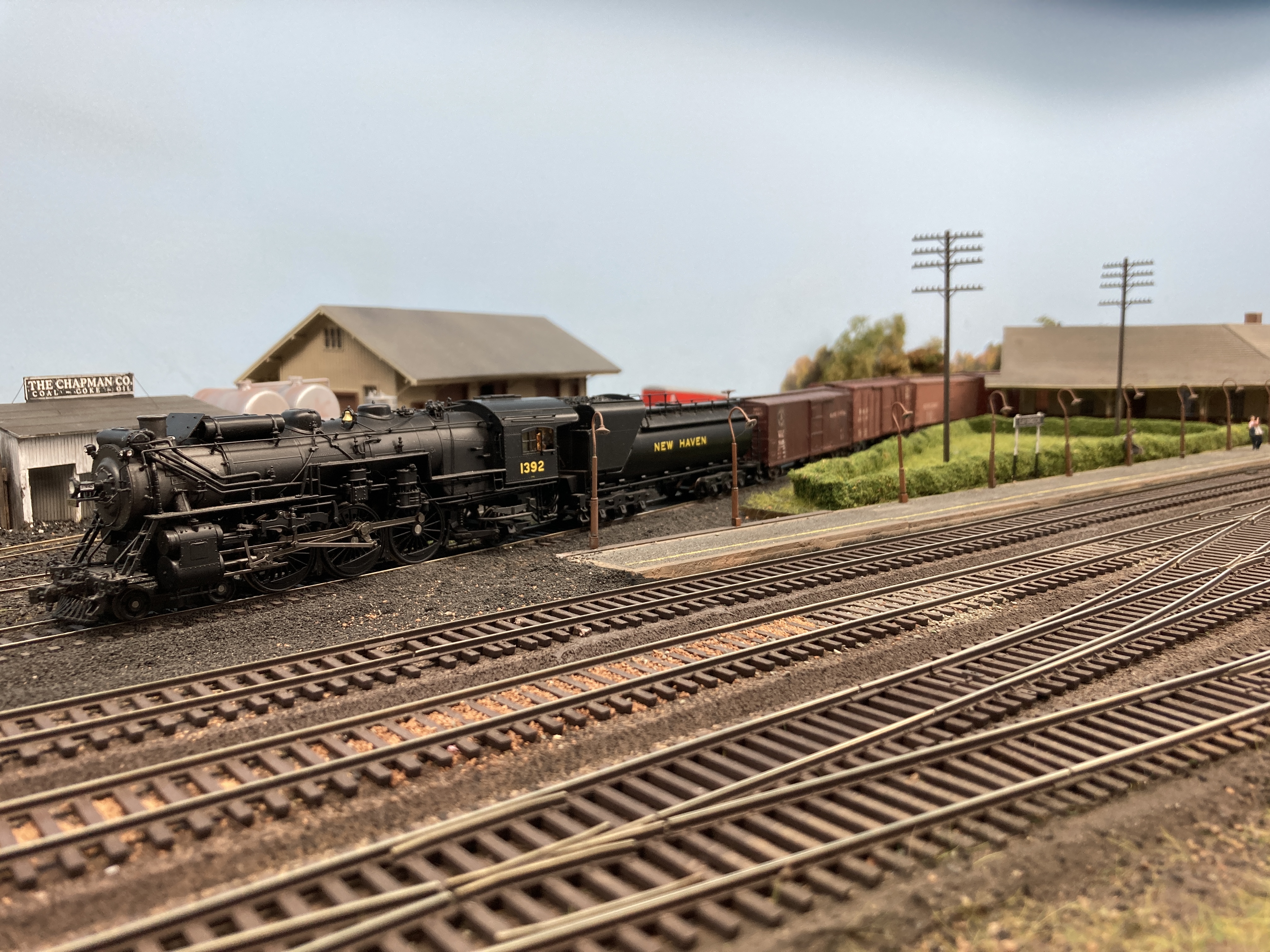
And what a train PDX-1 was this night! I-4 #1392 is such a beautiful locomotive, it's a real shame I've only run it a few times since I got it almost 7(?!) years ago. While technically a passenger engine, toward the end of steam ops in the late '40s, the New Haven occasionally used I-4s in local freight service - and even occasionally as pushers eastbound out of Cedar Hill yard. I think it looks pretty great on freight, if you ask me. Although I had to stage this train here rather than have it run behind the station on Track 6. The radius back there is just a bit too tight for it not to derail.

PDX-1 is probably the most varied of all the job assignments on the railroad. "All" it does is come eastbound into Saybrook (ostensibly from Cedar Hill Yard in New Haven), switches the local industries, leaves westbound cars for PDX-2 (westbound local) and picks up all eastbound cars. BUT, to do so requires finding rare windows of opportunity to cross the busy double-tracked mainline - twice! So there may not be tons of switching, but there's definitely a bit of stress - punctuated by waiting for, and watching, the parade of passenger trains rolling by.

Up on the branch though, it's a different world. After crewing PDX-1, Pieter and I took the helm of PDX-2, which runs up the Valley Line through Essex and Deep River to East Haddam before returning to Saybrook and continuing west to Cedar Hill yard. That's Pieter in the distance switching Essex, while Tom figures out his next move out of Cedar Hill.

Sometimes, the model works exactly as the prototype. And in this case, the north end and south end Valley Locals (HDX-7 and PDX-2, respectively) ended up meeting in East Haddam. That's the good news. The "bad" news is that when that happens the aisles can get a bit, um, "snug."  ChrisZ photobombs from HDX-12 for good measure.

Not being as pressed for time as the Shore Line local, HDX-7 is responsible for the switching in East Haddam, so Jim and Bill use their steam power to transfer some cars to PDX-2 while its diesel waits on the main. It was about this time that Murphy decided to make 343's brake full on/full off. So much for finesse...

Did someone say "diesel"?! Mr. Murphy apparently thought dimly of our all-steam session. Chris' #278 on the Airline local was the first to give us fits - until we discovered that the shorting issues were more likely due to turned-trucks on the brass caboose rather than the loco. But we didn't figure that out until DEY- (S-2) #615 was pressed into service. Once we swapped the offending caboose out, #278 was back on the point and finished the session in fine fashion.... and just in time for the 615 to go over and rescue PDX-2 who's R-1 (ESU-equipped Bachmann 4-8-2) inexplicably started bucking, balking and generally behaving badly. But, just like the prototype, what the diesel lacks in charm and charisma it makes up in reliability and performance. Above is the 615 switching Deep River on its way southbound back to Saybrook.

Thankfully, PDX-2 made it back to the junction without any further incident and held clear of the main while waiting clearance to enter Cedar Hill.

After meeting with PDX-2 in East Haddam, HDX-7 The Valley Local headed back to Hartford and here we catch it as it goes through Wethersfield northbound.

If you have a layout of just about any size, no matter how small, you're unlikely to have many - if any - incident-free sessions. Mr. Murphy always has a way of making mischief. The resulting punch list catalogs his greatest hits of this session:
  • Check/fix wheels on caboose #C-301 for proper orientation/polarity
  • Check/fix brake function on #343 (reset/reload decoder?)
  • Check/fix operation of #3304 (reset/reload decoder?)
  • Check/fix lighting functions on #0615
  • (Re)fix shorting at north end of Wethersfield (south end of reversing section)
  • Check/fix south grade crossing in Mill Hollow (#278 derailed here, backing southbound)
  • Consider installing rerailer at end of Cedar Hill Track 1 to facilitate freight moves
  • Shave some layout from in front of Dickinson Witch Hazel coal track to widen the aisle
  • (and all the way back to the beginning of the evening...) Fix throttle cable socket on the ProCab
It's true that ops sessions are the best way to put your layout through its paces and show you what needs attention and/or what needs to be fixed. And with every ops session, that list usually gets shorter.

But it's also often true that the list may not get so much shorter, but different. I've been operating this layout in its current full form for about 6 years (actually, almost to the month!) and, like bubbles percolating up from your pond's freshly-poured resin, you never quite know where Murphy will manifest next. But the response is the same - you pop the bubble, tick off the punch list item, and improve your layout bit by little bit.

The cool thing though is that, no matter what Murphy has in mind, you'll have a lot of fun along the way. And if you have some great friends to help you along, that's even better.

Hope you're able to get to some modeling this weekend. I, for one, plan not only to get to some of these list items, but hope also to post some more progress on the DEY-5 build. Methinks Murphy's mischief will be mitigated by the marshalling of more modern machines...


Friday, September 24, 2021

Friday Fun - Ops Session Success!

Crew Register & Era-appropriate radio

Between "OP"toberfest last weekend and a Valley Line session last night, there's been lotsa operatin' goin' on lately. And it's about time - before last weekend, I hadn't been to an operating session since "COVID Eve" (literally the day before we were all sent home from work) at James Mayo's layout. And the last time I had a full Valley Line session (I'm not going to count the Spontaneously & Substantially Shorting Shakedown Session of Summer, 2021 since the Shore Line trains didn't run) was January 23, 2020.

Signing the Crew Register
Wow - It just occurred to me that last night's session was exactly 21 months to the day since the last session. And a Happy Anniversary it turned out to be! Despite the fact that I decided, again, to throw caution to the wind and this time try to run EVERYthing (including all the Shore Line trains, in addition to all four local freights, full tower operator/dispatcher with radio communications, wireless & WiFi throttles), everything operated great - certainly better than the S&SSSSofS.

I hope to start formal ops sessions next month, so this session was intended to be a Full Dress Rehearsal (hence, the trying everything) which would expose any additional problems that need to be fixed for reliability. Other than some relatively minor equipment issues (the trucks on a couple of brass cabooses and under the tender of one of the brass steamers decided to pick switch points a few times) and some stress due to not having operated So Many Trains in almost 2 yrs, there's really nothing huge to add to the Punch List. . .
  • Since returning all the "leased" cars (borrowed from BillS), I discovered I need more flatcars and gons.
  • Need to edit/update some of my documents (spreadsheet, checklist, ops protocols, bulletin order)
  • Definitely need to update/change the trackplan on the Saybrook Control Board to reflect long-ago changes to the track arrangement (and need to do the same for the Dividend track map to reflect more recent changes).
Most importantly, the shorting seems to be solved! The only shorts were related to the equipment issues mentioned above, or when the folks in Shore Line staging were trying to rail cars when making up trains.

The only other thing to report is that the way I do my operations continues to evolve. For years (literally) I operated with switchlists only (see here), and then - when I realized I needed SOME sort of car card to go with cars that have to be transferred between trains - I added "Car Transfer" forms to the switchlists. 

But those were never really all that prototypical, so I created paperwork for each car that needed to be transferred to go along with the switchlists (see here). And starting last night, I decided to just create paperwork for all the cars (waybills for loaded cars and empty car bills for empties) and get rid of the switchlists. It's a little more work (just adds a little more time to what is a lot of work to set up), and a lot more handwriting, but it's a LOT more prototypical.

I'll plan to do a separate post on my ops paperwork soon (and will be soliciting feedback), but that's enough writing/reading for now. Here are some photos from the session - enjoy!

Roman bringing PDX-1 eastbound into Old Saybrook

Pieter (center) bringing PDX-2 into Saybrook while the tower operator (Bill) makes sure neither he nor PDX-1 foul the Shore Line 

Tom (foreground) works "West End" staging while Pete works the Airline local in Somerset

Randy & Dick operate the Valley Local in Wethersfield

Pieter's made it into Essex while Tom looks on

It's fun watching the parade of trains through Old Saybrook from the "bleachers" (basement stairs)

Pete's made it to Middletown with the Airline local, while Dick switches the north end of yard

Bob looks on from "East End" staging while Pieter finishes his work with PDX-2 on the Saybrook wye


Friday, August 6, 2021

Admiral Farragut would be proud...


A few weeks back, July 15 to be exact, I held my first operating session since January 23, 2020. Given how long it had been since I've had others operating on the Valley Line, it was intended to be a "shake down" session to see how the railroad has fared over such a long period of inactivity. As such, I should have checked my expectations at the top of the basement stairs. If I had, I probably would have had more fun.
My co-crewmember on the Valley Local, PieterR, before things started to devolve...

It all started out typically & innocently enough. I did my usual ops session setup (a process I'm really trying to streamline) and invited a small group of my regular crew over to run the trains. One of the nice aspects of my railroad is that I can operate with as few as one or as many as 13 people, so I knew I'd get a session in no matter how many showed up. As it was, I only had to annul the Shore Line trains and the short local (PDX-1), opting to have 2 man crews on the Airline & Valley Locals and just TomD on the westbound Shore Line local (PDX-2).

So far so good.  But then I did what turned out - perhaps - to be the equivalent of poking Fate in the eye . . . I decided all the trains would be steam powered(!)

Yup, three New England Rail Service New Haven Railroad K-class moguls - all brass - ran at the point of the three locals. I've run them all before and they run as beautifully as they look. Bur for some reason, about 30 minutes into the session, they all took turns shorting out the layout. ARGH!

Now, more reasonable folks would have taken that opportunity to remind themselves that this was supposed to be a shake down session - to see what inevitable glitches may have cropped up over the year-and-a-half of idleness - to create a punch list of items to address - to, even perhaps, actually address those items as they cropped up.

But no - not me. With every irritating, incessant beeping of every short circuit indicated, I just became more aggravated and determined to Keep Going At All Costs, trying to WILL the layout into behaving.

Yeah. That didn't work so well.

Thankfully, my crew is not only good humored and patient, but it turned out they had much more reasonable expectations of the session than I did. And, as a result of cooler heads prevailing, I got the punch list I'd sought by scheduling the session in the first place (and that I, apparently, subconsciously sought to avoid by plowing ahead):

  • Reset and Reprogram the decoders in all the steam locomotives.
    • All the shorting may have affected the electronics, so best to do a "clean reboot" to remove that variable. See the videos below for some of what I'm experiencing.
  • Run all the steamers in the dark to check for any arching.
    • While they've run fine in the past, brass steam locomotives are notorious for developing short circuits over time as paint wears and parts come into contact with each other.
  • Run some metal wheelsets through all the turnouts/frogs.
    • One of my COVID projects was to do a thorough cleaning of all the rails and apply graphite.
    • Despite my efforts to apply it very sparingly (a little goes a very long way), I may have been a bit heavy handed in some places and any rough spots - typically at rail joints and frogs - may have knocked off more graphite causing more to be applied. 
    • Too much graphite may have caused some bridging of electrical gaps. But once it burns off, it's fine.
  • Reintroduce just one steamer at a time at future ops sessions.
    • In the meantime, I'll be running all-diesel sessions.
On that last point, I've been surprised to discover that I actually don't have enough appropriate diesels to run a full session(!) I have DL-109s (New Haven class DER-1) up the ying yang for all the Shore Line trains, but precious little internal combustion for the local freights. In 1948/49, the locals were powered primarily by DEY-3 and 5 class switchers (Alco S-1s and 2s). Unfortunately (depending on your perspective), the New Haven's Alco S-1s and 2s had a special low-profile cab.

Fortunately, my friend MikeR has created a kit for that unique cab, and my friend JoeS has blazed the trail in building one (and shared his process with us all).


So, I have an undec Atlas S-2 on my bench, ready to be converted into NH DEY-5 #0604, and a Proto2000 undec S-1 waiting for a decoder and Scale Sound Systems speaker (been dying to try one out) before being converted into the Valley Local's #0967.

Though it's on my bench, the 0604 may have to wait until I straighten out her teakettle sisters. If you have any thoughts/suggestions after watching these videos, be sure to let me know in the comments. In the meantime, I'm planning the next shake-down session - and planning on keeping my expectations in check.


Monday, July 16, 2018

Modeling Monday - Weekend Working the the Punch List

I don't work on the punch list as often as I'd like,
but when I do, it's usually on the weekends.

I mentioned in my last ops session report that one of the things such sessions are great for is seeing what you need to fix/address on your layout. Hopefully, over time, those lists of "to dos" will get smaller and smaller. I don't think they ever totally go away - there's always something to do. And if the layout's been dormant for a bit, the lists can get fairly long . . .

This is my fairly-typical list of things to do - some coupler issues, some programming issues, and a couple misc suggestions.

Speaking of suggestions, here's a list from one of my regular crew members, Randy. Beware of asking your crewmembers for Punch List items. They may just provide you with a few! 
As you can see, I've already knocked a few things off these lists - either by actually doing them, or - in the case of a few on Randy's list - moving them from one list to another.


The first thing I did was something that wasn't suggested by anybody, but I think will come in "handy" for the New Haven/Points West staging operator/mole. (sorry - couldn't resist the pun). For too long, I've been opening the staging box by grabbing that splice with my fingers. I'm actually a little embarrassed that it's taken me til now to just put a cheap little handle there. Much easier!

Next, I tackled the radio antenna/Berlin Branch plug-in issue I mentioned in my last ops report. I'd started having a lot of problems with the radio throttles losing connection and I discovered the problem was that the cab bus splitter I'd installed was being weighed down by the bus itself and losing contact in the socket. So, for this past session, I just cut out the Berlin Branch part of the cab bus and plugged the antenna in directly. The solution (short of buying/trying additional splitters) was to just prop up the splitter . . .

Found a scrap piece from cutting the "lips" off my AC Moore bill boxes (I don't throw ANYthing away), moved it up against the splitter, and clamped it in place.


Not all that elegant or pretty - and probably not a permanent solution - but problem certainly solved for now.

Another thing I noticed after this past session - though unreported by anyone that I recall - is that the long manual turnout throw in the Middletown Yard broke, a little bit.


As you can see in the photo above, the push rod (coat hanger, coming from the right) has slid over to the fulcrum-end of the actuating rod. Definitely not good for easy throwing of the turnout. The push rod needs to be at the far right end of the actuating rod. Thus:


I'd tried bending loops to keep everything connected, but it was especially hard to do so working under the benchwork - and trying not to break anything in the process. So, I'd just soldered a piece of wire onto the actuating wire to act as a "bumper/guide" to keep the push rod from sliding toward the fulcrum.

It was that little piece of soldered-on wire which finally broke off.

I figured another soldered-on piece of wire would eventually fail again - and, besides, I frankly didn't feel like getting out the soldering iron or gun and soldering above my head. So, after a bit of figurin' here's what I came up with...


Yup - just a plain ol' clothespin, clamped onto the actuating rod. It keeps the push rod from sliding around and is just the right width. I'd considered using an alligator clip to do the same thing, but I found the clothespin first. And I have a lot more clothespins than I do alligator clips. . .

And now I'm in loco maintenance hell.


So far, it's "just" adjusting couplers, but I'm discovering that the pilot couplers on all my DL-109s are droopy/low and there's no easy way to fix them. At least no quick solution so far...


If any of you have had the same experience with these engines (Proto 1000 DL-109s) and have a solution, please let me know. In the meantime, I may try to grind away some of the frame to raise the coupler. Fortunately, I don't have that far to go. Unfortunately, it's enough that not fixing it ensures that I'll lose my train from time-to-time. Like the Yankee Clipper. Which would be embarrassing. Especially during an open house. Ask me how I know.

But all in all, none of these punch list items are all that difficult. They just take a bit of time. Sure - it's time I'd rather be spending doing something else on the layout, but as I keep saying - like bubbles on a newly-poured resin pond, eventually they'll all be popped and when they are we can experience the joy that comes from operating a layout that performs flawlessly and maintains the illusion of that time machine many of us strive for.

Friday, November 17, 2017

Friday Fun: NER Convention Ops Session

Way back in May, I was invited to participate in this year's NMRA/Northeast Region Convention operating sessions, which would entail me opening the layout to any convention attendees that wanted a chance to run on the Valley Line. Since my ops sessions had up to that point been limited to those that help build the layout and other close friends, the prospect of inviting "all and sundry" was a little intimidating at first. In fact, I even posted about my concerns here (and subsequently in Model Railroad Hobbyist magazine here).

But I needn't have worried at all. I'd already planned on having some of my regulars as "pilots" on the 4 locals, if only to provide helpful tips/hints to newbie operators along the way. And as it turned out, over 1/2 of the conventioneers that showed up were folks I already knew or was acquainted with. In fact, the only one I knew only by email was the guys responsible for organizing the NER sessions themselves. So I figured all would be well.

And it was. In fact, like most (if not all) of my sessions, it was a blast. Heh - at least *I* thought so. Getting to see the layout come to life is the goal of every session host; it's the operators that have the challenge of navigating the session that the host created.

This session was like my previous ones with a few new innovations. Now, instead of each crew having to report to the agent in each town to get their paperwork and go "on sheet," they sign a Train Register and get their paperwork from new boxes I've installed at each station.  Click here for more detail on that process and how it's evolved.

I also decided to try staggering the crew start times to reduce congestion, especially at Old Saybrook. When the railroad has two-man crews on the locals, I can easily require 11 people to operate the layout (8 on locals, 1 "mole" in each staging yard, 1 A/O). And with 2 locals in Saybrook at the same time, other locals waiting to get started, and mainline trains going through as well, it can get very crowded. I didn't want to reduce crew size (and limit the fun!), so this time I got the Valley Local started first (they have the longest day), got the Airline local out next (and out of the way), and just had PDX-1 (by far the shortest job) be the only train with a 1-man crew.

That did the trick - everybody staggered out nicely and didn't run into any congestion. Now, if I could just do something about the liftouts/duckunders.......

So with all that as prologue, here are some photos from a great afternoon running trains on the Valley Line:

Mike Redden, Randy Hammill & Pete Luchini - Randy is the head operator at New London/Fort Yard staging (representing "points east" to Boston) and is explaining why some changes are necessary. Mike is acting as Randy's apprentice, getting qualified to run the yard in the future. And Pete is sole-operator of PDX-1 in Old Saybrook.

Meanwhile, at the "other end of the line" in New Haven/Cedar Hill Yard staging (representing "points west" to New York), Tom Derwin is getting another eastbound train ready to go, while Dave Ramos and Al Oneto are on PDX-2, trying to figure out how to switch Essex.

Further up the Valley Line in Wethersfield, James Mayo acts as conductor on HDX-7 (The Valley Local) while Sudro Brown keeps a firm hand on the throttle.

Heading back down the Valley and banging a westward turn at Middletown, we find Bill Schneider and Howard Miller working the Airline local at Mill Hollow.

A better shot of Tom, Dave and Al - all smiles . . .

. . . . until they realize they're still not done switching Essex.

As typically happens - on the model railroad as well as on the prototype - the Airline local and the Valley local are in Middletown at the same time. Well, actually, in this case, they're in the "Middletown Aisle" at the same time - HDX-7 is actually still in Rocky Hill at this point.

After finishing Essex, Dave and Al discovered that the rest of the work goes pretty quickly. Here they are back at the south end of the Valley Line in Old Saybrook having already done their work up to East Haddam and back. They're waiting for permission from the dispatcher (um, who's taking the photo) to occupy Main Track 1 so they can  continue to Cedar Hill Yard and home.
Despite my initial misgivings - especially with regard to crew size/congestion - this was probably one of the most successful sessions to date - definitely since the Shore Line got into full operation. The layout ran well (with only a couple minor glitches at the beginning, despite having JUST tested everything an hour beforehand!), there were no major incidents, and everybody seemed to have a great time.

But - as is always the case with ops sessions - a few punch list items surfaced:

  • Some couplers have developed issues - specifically, I need to (re)check the coupler heights on all the DER-1s (DL-109s) as well as the centering on the DERS-1b (RS-1) and a few freight cars.
  • Even though I distinguished operating notes for the Shore Line trains (so the operators know clearly which notes pertain to them), I'm considering just creating separate sheets for each of the Shore Line operators to make the schedule easier to follow and the staging easier to execute.
  • I need to check the trackwork at the east (left) end of the Saybrook station area, as well as tweak the Airline liftout. Seems about this time every year I have a similar issue, due to seasonal expansion/contraction. No derailments (thankfully), but any height-mismatched couplers would tend to disengage in these areas.
  • And - a first for this session - the main power toggle switch got bumped and shut down the layout. So I'm considering putting a toggle guard around it to prevent future unintended shutdowns. %^)
  • Finally, signing of the Train Registers in each town was spotty. So I'm considering returning to in-person reporting to the Agent. Then they'll HAVE to report in - if only to know what work they have to do in town >:^)
Comparing this list to previous punch lists, it's gratifying to see that the quirks are being worked out of the layout over time. That sort of improvement is one of the reasons to host regular operating sessions - but it's certainly not the most important reason.

THAT is to have a chance to have friends - and future friends - over to share in the love of railroading and help get the time machine we've created off the ground and running.

Thanks again to Mike, Randy, Pete, Dave, Al, Tom, Howard, Bill, Sudro, and James for making it such a great day! I'm already looking forward to the next session (as soon as I can get through the punch list...)


Tuesday, February 7, 2017

Quick Update

It's getting into my busy time at work, so I've used what little free time I have working on the layout rather than blogging - and there's been precious little free time, unfortunately. I haven't even been able to host the (now-no-longer weekly) Photo Library Night for a while now. But that's ok - my work schedule is predictable (it's extra busy around the same time every year) and I have some good friends helping out when they can.

Speaking of friends - and by way of a very quick mention of the Springfield show - thank you to all of you that took a moment to mention that you read this here blog. I'm not gonna lie - my head did grow just the tiniest little bit, but only because I'm proud to be able to showcase some great work by great friends. And that you appreciate the effort is, in turn, MUCH appreciated. So Thank You!

And I was even able to add to the stable - yes, I got another New Haven K-1d, so now the Valley Line is totally covered motive-power-wise. I need only to get another J-1 class mikado to round out the Steam Era roster for my four locals. Some New England State Ltd magazines and scenery materials rounded out my purchases for a very successful day. The dinner with friends in the Parlor Car at the Steaming Tender Saturday night after the show was a perfect ending to a wonderful weekend with friends.

After Springfield, BillC and I spent that Sunday afternoon finishing up the leftover work from the Friday night ops session, and then took a deep dive into the Shoreline trains schedule. He took a long look at my staging script and I could almost hear his brain's gears meshing...

Here's what I started with:


which I thought was pretty good. But here's what he came up with after a few days:


All the trains are color coded by size and type, and each staging track is accounted for by occupancy and time. Suffice it to say there's a LOT of information packed into this 17"x33" chart, and I'll go into it in more detail in a future post (beware PeteL - this is your schedule too...). The good news - tentatively at least - is that it looks like I'll be able to run all 33 prototype trains during my ops session, just as the New Haven did according to the 1947 timetable. Pretty cool. Just have to do a "dress rehearsal session" to confirm...and maybe get more rolling stock...


Speaking of "Bill"s, BillS came over for a bit to help me destroy start reworking Wethersfield for what has to be the upteenth time. Long time readers will recall:
  • Finishing the trackwork in Wethersfield, then removing a long passing siding and reworking it all since JohnW mentioned that the siding was removed long before my era;
  • Lowering the backdrop since I needed to flatten the topography in the area to be more prototypical; and
  • Extending the bulk track since it was far too short for prototypical operations.
Well, suffice it to say, we're starting on the area around Goff Brook at the south end of Wethersfield and working our way north. And, as it turns out, the topography in the area has to be reworked yet again:


Yup - all that cardboard lattice and plaster cloth came out - as well as the Valley Coal siding. That would be why Bill brought in the extra large garbage can. All that stuff had to go somewhere...

To console myself a bit after this "2 steps forward, 1 step back" approach to layout building, I decided to install a few more throttle plug in panels. I'll go into that saga process also in a future post. But suffice it to say for now that if you want to add power to your cab bus, do not assume that "all you have to do is" plug a power supply into the power jack at the back of the panel. Nope. It's much more complicated and involves cutting PCB traces and soldering in little resistors. Like I said - that drama will be for another post.

After all this, I figured I could handle a couple simple things on my punch list from the last session. I have a "Three Strikes" rule for freight cars - if a car gets written up 3 times, it goes to the bench for a full working over. C&O double-door boxcar #9994 had coupler complaints one too many times, so I got rid of the Accurail "scale" coupler boxes and split-head couplers and replaced them with KD #58 scale couplers in KD boxes. I also added KD washers to raise the carbody:


I also did some "car raising" (bolster washer installing ) on CP 221026 and New Haven NE-5 caboose #555 and put all three cars back into service.


Now that those are off my bench, I hope I can get back to my DERS-1b and finally finish the detailing. With all the trains I need to be running soon, I'm going to need all the motive power I can get.

Ah! Speaking of motive power - thanks to the Missus, TomD, BartH, and BillS, I have an even dozen (and a few beautifully weathered and decoderized) DL-109s for my Shoreline trains. But - alas - more about those will also have to wait for a future post. Hope my work schedule calms down just a bit pretty soon so not only can I make some more progress, but I can get a chance to share it with you here.