Tuesday, September 12, 2017

Ops Session - 9/9/2017

The Annual Reunion for the New Haven Railroad Historical & Technical Association was moved up again this year and as has been my habit the past couple of years, I opened up the Valley Line to give folks visiting from out-of-town the chance to operate.

This time around there were a few changes/innovations from the most-recent ops session, which occurred just a little over a week previous. I was going to try one-man crews, but it turned out I had enough of a response that that only worked for one local. Even the Shoreline trains were fully staffed thanks to Tom - and good thing: turns out there was no way BillS would have been able to make it back & forth between "Points West" and "Points East" in time.

In order to cut down on the work the "desk jockey" has to do, I offloaded the Agent/Operator duty to a new "Train Register" located at each station. Now crews, instead of physically walking over to the desk to report their # of cars and get their work in town, they sign the register, note their cars, and take the switchlist and/or orders that are clipped to it for them.

Train Register, with work clipped for PDX-2.
This is in Saybrook - a town where two locals interchange cars. Other towns are served by only one local, so there's only one unlabeled binder clip that would hold their work/orders.
Currently, all that is on a small clipboard hanging from a cup hook in each town. I thought I'd be able to get away with that long-term, but operating a bit myself afterwards I concluded that I really need to install bill boxes asap. Now, "all" the guy at the desk has to do is operate the mainline switches as the Saybrook Towerman. With all the traffic through Saybrook, that'll be enough to keep him busy!

Secondly, it's been difficult in past sessions for the crews to keep track of the cars they have to hand off to each other. Since I don't have car cards or waybills, I needed a better alternative to just expecting they'd transcribe the info from their switchlist to another (for the receiving crew). So - at least for now - I've created a "Car Transfer Form":

Crews can use this form to keep track of the cars they know they need to hand off and either give it directly to the crew receiving the cars, or leave it for that crew to pick up later (on the clipboard or in the eventual bill box) if they're not in town at the same time. It's admittedly a bit contrived/non-prototypical, but it serves as a plausible stand-in until I can get around to doing waybills.

The final idea was to stagger the start times of the locals. Last session, it got a bit crowded in Saybrook with two locals in town at the same time, not to mention all the Shoreline trains going through. While that's perfectly in keeping with the prototype, it makes things a bit, um, "snug" in that area. Thankfully, it's also in keeping with the prototype to have the locals arrive in Saybrook at different times - which, in turn, means staggered starts.

But I've been hesitant to institute this innovation since it would require some folks to hang around waiting for their work to actually begin. But it turned out, since some of the guys were on the Reunion Dinner Train and arrived later in the evening anyway, we got to try it. It worked a bit to reduce congestion - but not as well as one-man crews will, I suspect.

So with all that as prologue, on to the session!

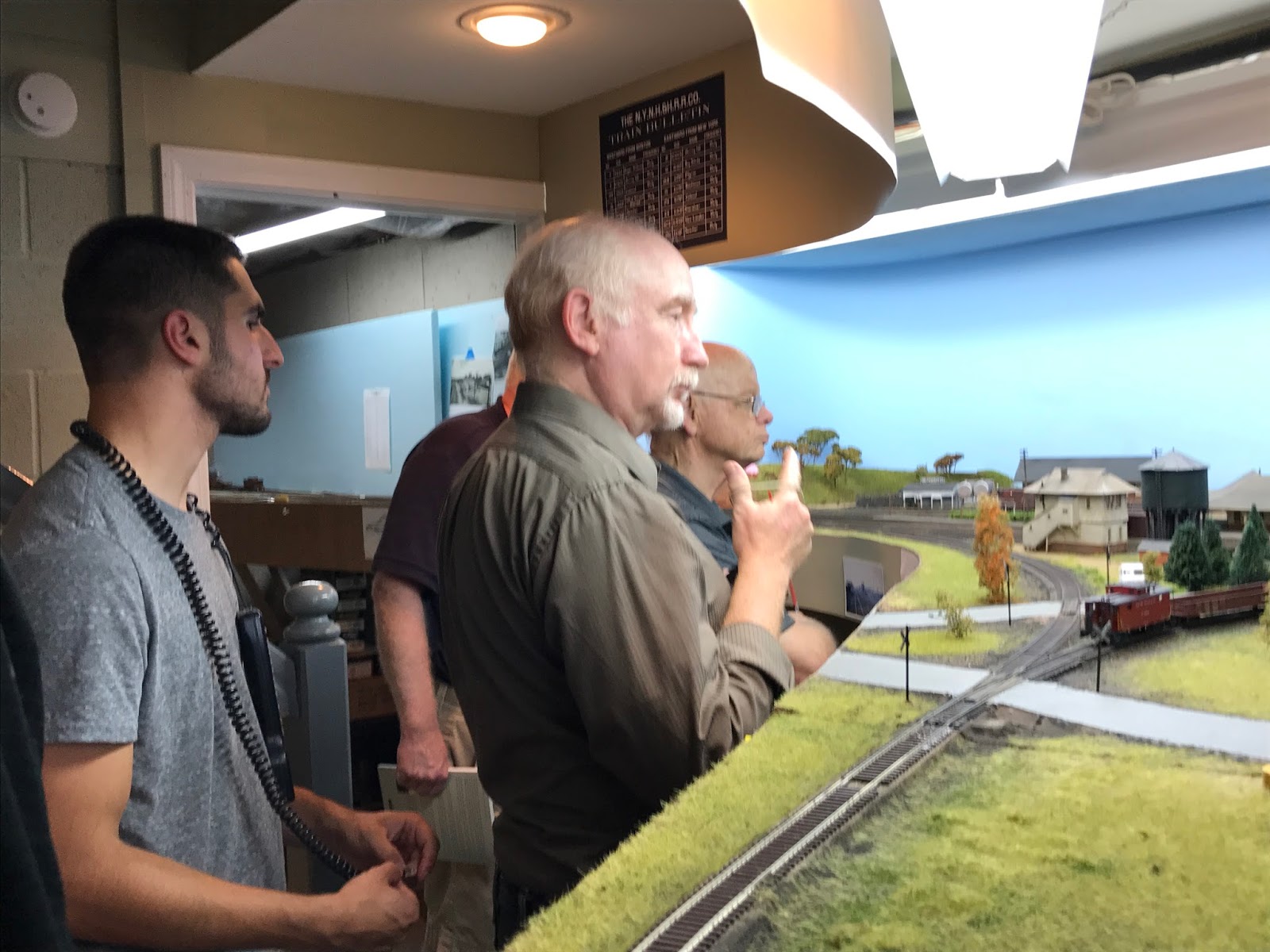
Bill C, Tom D, and first-timer Bill L at New London/East End staging - Tom was the east end mole and the "Bills" were crew on PDX-2 out of New London up to East Haddam and then on to Cedar Hill.

BillS was working the East End - all smiles since he doesn't have 4 guys on 2 crews to compete with for aisle space - yet.

Mike, having just arrived to crew PDX-1 solo, waits his turn to sign the Crew Register.

PeteL and another first-timer DonM work the Air Line Local (HDX-12) in Somerset.

2nd timer JimF and yet-another-first-timer DaveI all by their lonesome "way up in the chilly north on the branch" (i.e. in the other room with the windows open) working the Valley Local (HDX-7) in the Dividend section of Rocky Hill.
BillL switches the westbound Shoreline local (PDX-2) while Mike - on the eastbound Shoreline local (PDX-1) switches the house track in Old Saybrook.

More action at Saybrook Junction: PDX-2 (a.k.a. The Haddam Local) heading north up the Valley branch on the east leg of the wye while one of the many Shoreline express trains flies through town westbound.

Meanwhile up in Middletown, the crews of the Valley Local and the Air Line local coordinate their switching and car swapping. Good thing there's a nice wide aisle here. . .

. . . unlike at East Haddam, where the aisle is somewhat - er - narrow. This is where the Valley Local (on the left) and the Haddam Local (PDX-2, on the right) swap cars.
It was another really fun night with lots of laughter and a bit less stress than last time, due entirely to having the crews deal with each town agent via clipboard rather than in person. So I was able to enjoy the session a bit more - and even got to take these photos! As for the "laughter" part - well, I'll leave it to BillS to post his video of the Boston-bound Yankee Clipper. Let's just say, it didn't go quite as planned . . .

We had the usual minor glitches that every session seems to have - the occasional short (which, thankfully, was typically caused by human error and didn't shut down the layout), some confusion over the paperwork (I - admittedly - tend to have more of it than average), and some mechanical issues (mostly "prototypical" in nature - broken couplers, wonky engine operation, a derailment). But all in all - and at the risk of jinxing it - the layout is operating really well.

So, with all that in mind, here's my punch list/goals for next time:

  • Try one-man crews. It'll be interesting to see the trade-off between reduced congestion and added work for one guy (he'll have to man the throttle as well as manage the paperwork). I may keep the Valley Local as a two-man crew though, since it'd get awful lonely "way up north" all by oneself.
  • Related to the paperwork handling - install bill boxes. I've purchased 10 of those longer narrower ones (described here) since they seem more versatile and can hold more.
  • Be on the lookout for ways to reduce the paperwork a crew carries - e.g. perhaps the content of the Job Card can be on the fascia at the towns where ops tips would be helpful and maybe the Loco Card info (function key assignments) can be taped to the back of the throttle.
  • Speaking of paperwork, tweak the notes for the mainline moles to make it clearer which notes pertain to "Points West" staging and which pertain to "Points East" staging.
  • Further adjust/dial in the DCC settings on my engines, especially momentum. I'm still learning how best to do this so it's a lot of trial & error. Any help or guidance to good resources would be appreciated!
I'll be hosting a guest ops session during the NER convention in November, so I'm hoping to get a LOT more operations under my belt between now and then. In the meantime, and as always, please feel free to weigh in with feedback/tips/suggestions!

Monday, September 11, 2017

A Few Words about Wordless Wednesday #186


The above photo looks innocuous enough, but there's actually "More to the Story...."

During the Summer of 1945, the New Haven reballasted the Valley Line from Hartford south to Middletown. Well, "ballast" is a bit of an overstatement - no traprock here, mostly gravel - but still better than what was on the line further south (which was lucky to have cinders, hardpack dirt, or sand). And here we see the Valley Local southbound on the main, led by K-1d mogul #466 (the regular #356 being down for boiler wash or other maintenance), passing the work train on the siding, led by J-1 class mikado #3014 with a string of ballast cars. Location is just south of the Mill Street crossing in South Wethersfield.

I thought at first it was a John Wallace photo (same look, resulting from the Brownie camera, usual era, and he's the one who sent it to me), but it turns out one of the crew from the ballast train actually took the photo using John's camera. John's actually the kid in white, watching the local go by. Ted Michalicki is on the fireman's seat of the 466 and Dave Corsair was still in the Army (the War was still going on), but would be back on the local in the Fall.

Despite his white duds, John fired the 3014 for most of that day - not too difficult given the light duty of ballast spreading. Len Buckley was the engineer on the J-1 and even let John run the train back to Hartford (it had to back up the whole way since the south switch of the South Wethersfield siding had been taken out and the engine couldn't do a run-around).

Also of note is the New Haven's distinctive flanger sign - a horizontal white board with two dots. Remarkably, it was that sign that initially caught my eye in this photo. It wasn't until asking John about it that all this other great info came out.

And now - thanks to John's excellent memory (not to mention his photo, no matter who actually took it) - you know "the rest of the story."

Monday, September 4, 2017

Milestone Monday - First Full Ops Session!

Ah Labor Day - the "unofficial" end of summer and swimming in the pool. I'm not a swimmer myself, but I know the feeling of trying to get to the other end of the pool, head down, working hard towards my goal when . . .

THWACK!!

I hit my head on the wall at the other end of the pool. It's only then that I know, well and truly, that I finally met the goal I was working so hard to reach.

That's kinda what it was like during my latest operating session on the Valley Line.

Until I can automate things, ops session setup will continue to take as long (or longer) than the session itself, but it's "full size" railroad work - nothing HO scale about responding to customer "requests" (via spreadsheet), checking car numbers, assembling those cars into trains, and completing the paperwork that the crews need to do all their work of pickup and delivery according to rules & paperwork used by the railroad in the late 1940s. Add to that all the staging that's required to replicate a day on the New Haven's busy Shore Line, and you have a recipe for a LOT of work. And all without pay(!)

But "pay" comes in many forms and having folks over to take a ride in the time machine I'm attempting, and the fun and feedback I get in return - not to mention seeing my creation come to life - is priceless.

And during the most-recent session - and for the first time since doing the final expansion and all the shakedowns - I realized that the layout was coming to FULL life before my eyes: all four local freights operated with full two-man person crews (including the two Shoreline locals), "New London" and "New Haven" fully crewed and operating sixteen mainline trains through the Saybrook interlocking (run by fast clock according to the actual Sept. 26, 1948 prototype timetable), all coordinated (and not without a little stress) by yours truly in the Saybrook tower.

THWACK!

I had no idea until that moment that I'd reached such a milestone. I'd been working so hard and diligently towards this point that I almost missed its significance - until the realization hit me upside the head.

Thankfully, the session went really smoothly with only a few minor/inevitable glitches - all easily remedied for next time. After putting the layout through its paces so many times already, those gremlins are becoming ever more rare and the "punch list" becomes more a matter of minor tweaking and adding more realism to the sessions. Even the aisles weren't too crowded (at least not for long periods) despite having eleven (11!) folks operating at the same time.

Here's the cast of characters crew list for the evening:

  • The Valley Local (HDX-7): Bill Schneider and Jim Dufour (a special treat and first-time Valley Line operator)
  • The Air Line Local (HDX-12): Greg Lane and Kaylee Zheng (another treat, and only her 2nd time on the Valley)
  • Eastbound Shoreline Local (PDX-1): Pete Luchini & Bob Vancour
  • Westbound Shoreline Local (PDX-2): Pieter Roos & Roman Daniels
  • New Haven & Points West (aka staging mole 1): Randy Hammill
  • New London & Point East (aka staging mole 2): Tom Derwin

If there was any downside at all, it was that I was too busy during the session to really visit or take photos. Fortunately, we were able to visit during pizza beforehand and the Missus made a cake for afterwards. And for photos, a lot of folks chipped in with the pics they took. Thanks to them, I have a little recap of the session, told through photos and captions . . .

Jim Dufour photo
Last minute prep: Bill brought over a fantastic printout of a New Haven RR Train Bulletin, created from a prototype photo I'd found of the actual one in the Saybrook station. Yes, of course all those trains stop at Saybrook during a typical operating session - all according to the actual timetable the New Haven Railroad issued September 26, 1948.


I took this photo before all the chaos started - looks oh so tidy: Four clipboards containing paperwork for each of the four locals, including additional tools/helps on the steps, and the A/O-Towerman's desk all ready to go.

Kaylee Zheng photo
This view shows tracks 7 & 5 (left to right - NHRR track numbering) with cars spotted for the Shoreline locals. Track 7 is where cars destined for points east of Old Saybrook are spotted for Providence Division Extra #1 (PDX-1, the eastbound local freight from Cedar Hill Yard/New Haven to Fort Yard/New London). Track 5 is for the westbound cars, spotted for PDX-2 which works from New London to New Haven - as well as up the Valley Line to East Haddam.

Jim Dufour photo
 View showing cars spotted at The Chapman Co. ("Coal-Coke-Oil") and the Saybrook freight house.

Kaylee Zheng photo
Interior of the Saybrook Tower, showing the interlocking levers and "me" at the desk (click to enlarge). Modeling courtesy Bill Schneider.
Kaylee Zheng photo
And "actual" me at the Saybrook Tower desk, aligning switches for the next Shoreline express passenger train scheduled to speed through.

Jim Dufour photo
The Valley Local (Hartford Division Local #7 - aka HDX-7) starts off the session since it has the most work - up north on the branch and far away from the busy Shoreline. It leaves Hartford yard and heads south through Wethersfield and here the line crosses over the Goff Brook and into the town of Rocky Hill. While Bill did the scenery and bridge abutments, I can lay claim to the bridge itself and the "storied blogged" farmhouse.

Bill Schneider photo
After crossing Goff Brook, the Valley Local continues south and rounds the curve north of Rocky Hill station (observing the 10 m.p.h. speed restriction, as indicated in the timetable).

Jim Dufour photo
Southward view as the local enters Rocky Hill.

Kaylee Zheng photo
Valley Local in Middletown, with Bill acting as conductor/brakeman while Jim operates the throttle. The Airline Local must be in town as well since Kaylee took the photo and you can barely see Greg on the left. The two locals exchange cars at this point.
Bill Schneider photo
After the Valley Local finishes its work in Middletown, depending on the day of the week it heads either further south to East Haddam or up the branch to East Berlin. This shot shows the local heading south over the bridge at Shailerville (a section of Haddam, CT). That's the Connecticut River in the background.

Bill Schneider photo
This location, with its high bridge and distinctive abutments, is the scenic highlight on a line known for its wonderful scenery. It doesn't hurt that the Middlesex Turnpike (today's Rt. 154) is right alongside, affording easy access and a great view of the train passing by.

Jim Dufour photo
Attesting to its popularity among railfans, here we see Kaylee shooting the local as it heads back north after making its swap of cars with the Shoreline Local in Haddam. You can just make out the Turnpike and the Shad Shack by Kaylee's right hand.

Bill Schneider photo
After HDX-7 finishes its work in Haddam, it high-tails it back north to keep from outlawing. But it still has to pick up any northbound cars it had left along the way, so by the time it gets back to Wethersfield the local looks more like a through freight - as you can see in the photo above. Jim's taking everything the mogul's got and Greg must be wondering whether the old girl will make it. But the story of the Valley Local ends well - they made it back to Hartford in time for dinner.

Kaylee Zheng photo
Meanwhile, the Air Line Local has been busy working the (fictional) towns of Somerset and Mill Hollow on its way to swap cars with HDX-7 in Middletown. The photo above was shot just as the local was leaving Somerset on its way east.

Kaylee Zheng photo
We catch it again as it emerges from the tunnel and crosses the bridge at Draper (a flag stop on the way to Mill Hollow).
Kaylee Zheng photo
The crew must've been too busy to get any photos in Middletown, so we don't catch HDX-12 again until it's on its way back west to Cedar Hill yard. Here it is rolling past the engine facilities at the west end of Somerset. Since the Airline recently dieselized, the writing is on the wall for these distinctive buildings.

Jim Dufour photo
Finally, we see the two Shoreline locals - PDX-1 & 2 - doing their thing in Saybrook. Roman's manning the throttle on PDX-2 as Pieter gives signals. Pete looks on in the background, likely anticipating the arrival of yet-another Shoreline express.

Pieter Roos photo
Bob, from PDX-1, and Roman with Greg and me in the far background. That must've been when I was trying to get HH660 0924 started. Unfortunately, there aren't any photos of the unsung Heroes of the Shoreline - Randy and Tom, who spent the session "offstage" firing mainline trains at each other, each salvo followed by the eyes of those looking on (usually from the "bleachers" - the best seats in the house, aka the basement stairs).

Pieter Roos photo
And here's (kinda) where the session ended - PDX-2 (aka the westbound Shoreline local, aka The Haddam Local) sits on the west leg of the Saybrook wye, waiting for clearance to enter main track 1 and get on its way to Cedar Hill, while yet-another Shoreline express rolls by westbound.

Normally, the session ends when PDX-2 gets to New Haven. But they got to Saybrook right about when the afternoon rush started - they weren't gonna be able to get a clear track for a while. So we decided to call it a night. leave them on the wye, and head upstairs for cake.

Ah, cake - a fitting way to cap off a milestone evening, even if I didn't realize its full significance until the end.

A big thanks to regulars Bill, Randy, Tom, Pete, Pieter, Roman, Bob, and Greg, and to special guests Jim and Kaylee for doing such a great job in taking us all back to do some railroading in the lower Connecticut River Valley in the Autumn  of 1948.

Saturday, September 2, 2017

Another Rabbit Hole: Authentic Paperwork & Bill Boxes


I don't think I mentioned it before, but some time ago Max came across a cool log of New Haven RR train orders. It was available, it included orders for Valley Line and Air Line trains, so I had to get it.

But it's only been recently that I've been mining it to raise the level of authenticity in my operating sessions. I've been using actual NHRR Form 19 "flimsies" since the beginning to govern operations on my layout, but now not only will I be able to have the proper general language for train orders, but in some cases the actual, exact language for specific trains. The only thing different will be the dates (this logbook is from 1945 and I model c. 1948).

I also have a NHRR train register in my collection. According to the instructions, "Conductors will personally register their trains as soon as possible after their arrival at stations designated as 'Registering Stations.'" I've been using it as my "guest log" which crew members sign to "clock in" at the start of an operating session.

After my most recent session though, it occurred to me that I could use it as the basis for a train register form at each of the stations on my layout. Up to now, conductors had to see the Station Agent (usually me, manning the desk and Saybrook tower control board) and report the number of cars in his train, as well as get the work in town and any new orders. But acting as agent and tower operator at the same time is difficult, to say the least. So I'm considering installing bill boxes at each station to hold orders and switchlists.

But also at each station - just like on the prototype - the conductor will be required to sign the register and report the number of cars, as well as the time. And though it's authentic, it's not just busy work - it actually serves an important  role on a model railroad, giving me the train length and time data I need to tweak traffic and session duration.

After a lot of cutting & pasting of the prototype form to try and adapt it to model railroad use, I finally just used it as a guide to create a new form in Word:

Click to enlarge
Speaking of bill boxes, I'm considering two different types of pre-made boxes I found at A.C. Moore:

BION, Ted Dilorio found the long boxes and posted about them on his blog at about the same time I found them, totally independent of each other. Strange coincidence - then again, maybe not. Model railroaders are always seeking to adapt stuff.


Using either one of these will save me having to make them - and they only cost $1(!) so it's a no-brainer. Just need to decide which one to use. The one on the left looks more "bill boxy", despite the country look of the handle (though the handle provides a convenient attaching point - I have to remove one of them though). But it would require paperwork to be folded and it's too narrow for anything to be propped up in it.

The one on the right is a little more useful - it doesn't require as much paperwork-bending, and you can prop up your switchlists and such in it if you want. Only issues are that it sticks out into the aisle more, and it's a little more difficult to attach to the fascia.

Your thoughts?

Until I decide, I'll probably just hang small clipboards from cup hooks screwed to the fasica - or just use binder clips clipped to the top of the fascia (where I can).

But in the meantime, I'll enjoy looking over some old train orders from 72 years ago . . .

Friday, September 1, 2017

Fun Stuff Friday

At a recent Valley Line Ops Session, folks came bearing gifts and merchandise...


Tom brought an amazing P2k single-sheathed boxcar - one of the "Timesaver" kits that already has all the grabs installed. So, basically, I'll be able to add a craftsman-quality kit to the layout in about the time it would take for me to assemble a "shake the box" kit. And - bonus! - it even has the right date data already on it. Don't even have to change that! Thanks Tom!

And Randy brought a much-needed hopper by KD. Coal business is still in full swing, though starting to wane, on the Valley Line in the late 40s, so my hopper roster can always use another addition. Thanks much to Randy, that roster continues to grow!

Randy also - acting as unofficial UPS guy - "couriered" a purchase of another Stauffer tank car. I only have a few of these, and they're very distinctive. They're also critical to have on the Valley Line as these cars are one of the few mentioned by name in John Wallace's reminisces of operating on the Valley. They were commonly consigned to Hartford Rayon in Dividend (south side of Rocky Hill). Unfortunately, models are not all that common and I don't feel like scratchbuilding them, so whenever a model's produced, I try and get it. Thanks again to Randy for the delivery.


And finally, after long last and many years of dedicated effort, Max's book is finally out - and delivered (and signed by) the Author himself! I first got the good news this book was starting production back in March (see that post here), but now it's actually available in all its glory. It's an absolute must-have for the Valley Line aficionado, and any fan of New England railroading. You can order it at Amazon here - even though it says it's not available until Sept. 5, I know for a fact they're already being shipped out. So get your copy while you can (only a few left at Amazon as of this writing).

So LOTS of fun to share this Friday! Hope you and yours have a wonderful holiday weekend!